
The Northern White Rhino (Ceratotherium simum cottoni) is one of the most powerful symbols of the global extinction crisis—and also one of the most ambitious frontiers in modern conservation science.
Once ranging across parts of Central and East Africa, this rhino subspecies has been pushed to the brink by poaching, conflict, and habitat loss. Today, the last known Northern White Rhinos live at Ol Pejeta Conservancy in Kenya, protected around the clock and supported by an international scientific effort that aims not just to save a species—but to bring it back from functional extinction.
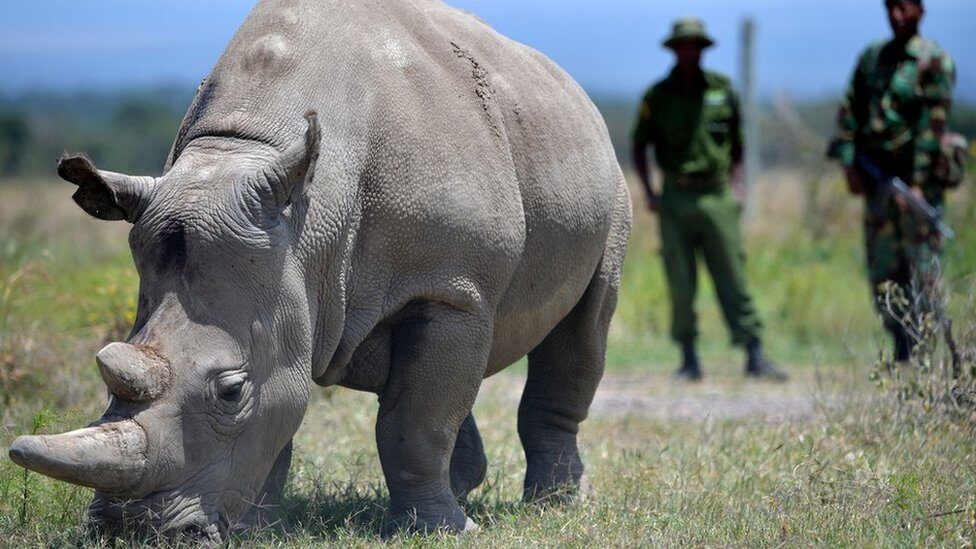
This guide explains what the Northern White Rhino is, how it declined, why Ol Pejeta matters, what science is doing to help, and what the future may hold—all in one place.
At a Glance: Northern White Rhino & Ol Pejeta
- Common name: Northern White Rhino
- Scientific name: Ceratotherium simum cottoni
- Family: Rhinocerotidae
- Closest relative: Southern White Rhino (Ceratotherium simum simum)
- Conservation status: Functionally extinct (no breeding population)
- Current location: Ol Pejeta Conservancy, Laikipia County, Kenya
- Why Ol Pejeta matters: Home to the last surviving individuals and the global center for conservation, security, and assisted reproduction research for the subspecies
What Is the Northern White Rhino?
The Northern White Rhino is a subspecies of the White Rhino(C. s. cottoni), distinguished historically by its range, skull and dental characteristics, and genetic profile. While closely related to the Southern White Rhino, it evolved separately and occupied a different ecological niche across Uganda, South Sudan, the Democratic Republic of Congo, and parts of Central Africa.
Like all white rhinos, it is:
- A mega-herbivore, shaping grassland ecosystems
- A grazing specialist, preferring short-grass plains
- A keystone species, influencing habitat structure for many other animals
Historical Range and Decline
Former Distribution
The Northern White Rhino once ranged across:
- Northern Uganda
- South Sudan
- Eastern Democratic Republic of Congo
- Central African savanna and grassland mosaics
The Main Drivers of Collapse
- Poaching for horn: Demand for rhino horn in illegal wildlife markets was the single biggest driver of decline.
- Armed conflict: Wars and instability in Central Africa made conservation enforcement nearly impossible.
- Habitat loss: Expanding agriculture and settlement fragmented remaining habitat.
- Weak protection in range states: Protected areas were underfunded and under-resourced during critical decades.
By the early 2000s, wild populations had effectively disappeared.
Decline: From a Widespread Grazer to Extinct in the Wild
The collapse of the Northern White Rhino (Ceratotherium simum cottoni) was not sudden—it was the outcome of decades of escalating pressure across Central and East Africa, driven by a lethal convergence of:
- Intense poaching for rhino horn, fueled by international illegal markets
- Civil wars and chronic political instability in key range states (notably parts of today’s DRC, South Sudan, and surrounding regions)
- Collapse of conservation enforcement in conflict zones, where protected areas became inaccessible or unmanageable
- Habitat loss and fragmentation, which reduced already stressed populations into smaller, more vulnerable remnants
In the early 20th century, northern white rhinos were still relatively numerous, with historical estimates suggesting more than 3,000 individuals across their range in Central and East Africa. By the 1960s, however, that figure had already fallen to around 2,250 animals, reflecting decades of overhunting and weak protection.
The most catastrophic phase came in the late 20th century, when poaching intensified and armed conflict spread across much of the subspecies’ remaining range. By 1998, surveys indicated that only about 25 northern white rhinos were still known to exist in the wild, primarily in the Democratic Republic of the Congo. Even these last survivors could not be adequately protected in the prevailing security conditions.
From there, the final collapse was rapid. Continued poaching, combined with the breakdown of conservation management in conflict-affected landscapes, eliminated the last viable wild populations. What remained were a few individuals in captivity and managed reserves—too few, and with too little demographic resilience, to recover naturally.
Today, the Northern White Rhino is officially classified as extinct in the wild. Only two females survive, both living under constant protection at Ol Pejeta Conservancy in Kenya. With no breeding male and no possibility of natural reproduction, the subspecies is now considered functionally extinct, and its future depends entirely on advanced reproductive technologies and long-term genetic rescue efforts.
This trajectory—from thousands to dozens, from dozens to two—stands as one of the starkest examples of how quickly even the largest and most iconic African mammals can be pushed to the very edge of extinction when poaching, conflict, and governance failure converge.
How the Northern White Rhino Ended Up at Ol Pejeta
A small number of Northern White Rhinos survived in captivity and protected reserves. Over time, it became clear that security, veterinary care, and international scientific collaboration would be essential if the subspecies had any chance at survival.
Ol Pejeta Conservancy in Kenya was selected because it offers:
- World-class security and anti-poaching infrastructure
- Experienced rhino management teams
- Large, well-managed savanna habitat
- Strong partnerships with global conservation and research institutions
The remaining Northern White Rhinos were transferred to Ol Pejeta, where they now live under 24/7 armed protection and constant veterinary monitoring.
Why Ol Pejeta? The Move That Changed Everything (2009)
The critical translocation
On 20 December 2009, four of the world’s last seven Northern White Rhinos—Najin, Fatu, Sudan, and Suni—were moved from Dvůr Králové Zoo in the Czech Republic to Ol Pejeta Conservancy in Kenya.
All previous breeding attempts in Europe had failed. The hope was that East Africa’s climate, open space, and natural grasslands—closer to the subspecies’ original ecological conditions—might stimulate natural breeding.
This decision transformed Ol Pejeta into the global stronghold for the Northern White Rhino.
The Breeding Efforts—and the Setbacks
Early hope
In 2012, optimism rose when Suni was observed mating with Najin. But as the 16-month gestation period passed, it became clear that Najin was not pregnant.
With numbers so low, conservationists attempted another strategy: introducing a Southern White Rhino male to Fatu and Najin in the hope of producing offspring that could at least preserve some Northern White Rhino genes. This, too, proved unsuccessful.
The losses
- October 2014: Suni died of natural causes.
- Early 2015: Veterinary examinations revealed devastating news—neither Najin nor Fatu could reproduce naturally, and Sudan’s sperm count was extremely low due to age.
- July 2015: Nabire (in the Czech Republic) died.
- November 2015: Nola (in San Diego Zoo) died.
This left just three Northern White Rhinos on Earth.
The end of natural breeding
On 19 March 2018, Sudan—the last male Northern White Rhino—died after suffering from age-related health problems and infections. When he could no longer stand and was clearly in distress, veterinarians made the humane decision to euthanize him.
With Sudan’s death, natural reproduction became impossible. Only Najin and Fatu remain.
What “Functionally Extinct” Means
The Northern White Rhino still exists biologically—but:
- There is no breeding male
- The remaining females cannot reproduce naturally
- There is no self-sustaining population
This is why the subspecies is described as functionally extinct. Its future now depends entirely on advanced reproductive science.
Ol Pejeta Conservancy: The Global Stronghold for Rhino Conservation
About Ol Pejeta
- Location: Laikipia County, central Kenya
- Ecosystem: Savanna, grassland, and woodland mosaic
- Known for:
- The largest black rhino sanctuary in East Africa
- A major population of southern white rhinos
- The last Northern White Rhinos
- Strong community and conservation programs
Why Ol Pejeta Is Uniquely Suited
- High-security environment: Armed ranger units, surveillance, and rapid response
- Advanced veterinary capacity: On-site wildlife vets and research partnerships
- Conservation-first management: Tourism directly funds protection and research
- Scientific partnerships: Collaboration with international reproductive biology and genetics teams
The Science: Can the Northern White Rhino Be Brought Back?
The Northern White Rhino has become one of the world’s most important conservation science case studies.
Key Approaches Being Used
- Cryopreserved genetic material:
Genetic samples (eggs, sperm, tissue) from Northern White Rhinos have been preserved for future use. - In vitro fertilization (IVF):
Scientists are working to create Northern White Rhino embryos using advanced reproductive technologies. - Surrogate mothers:
The closely related Southern White Rhino is being studied as a potential surrogate to carry Northern White Rhino embryos. - Stem cell and genetic research:
Cutting-edge techniques aim to expand the genetic base and improve the chances of producing healthy offspring.
Why This Matters Beyond Rhinos
This work is not just about one subspecies. It is:
- A test case for de-extinction-adjacent conservation
- A model for saving species with tiny remaining populations
- A frontier for applied wildlife reproductive science
Ethics and Conservation Debate
The Northern White Rhino project raises important questions:
- Should we invest heavily in high-tech rescue of one subspecies when many others are threatened?
- Can assisted reproduction become a practical tool for conservation at scale?
- Where should the balance lie between habitat protection, anti-poaching, and genetic rescue?
Ol Pejeta’s approach is to do both: protect living ecosystems now, while also pushing the boundaries of what conservation science can achieve for the future.
How the Northern White Rhino Fits into Kenya’s Wider Rhino Conservation
Kenya is a global leader in rhino conservation, with:
- Strong protection for black rhinos
- Growing populations of southern white rhinos
- Well-managed sanctuaries like Ol Pejeta, Lake Nakuru, and others
The Northern White Rhino effort sits at the most advanced edge of this broader strategy: combining security, habitat management, veterinary care, and science.
Ol Pejeta’s Wider Rhino Role
Ol Pejeta is not only home to the last Northern White Rhinos. It is also:
- A sanctuary for over 165 critically endangered black rhinos
- One of the most important rhino strongholds in East Africa
- A leader in armed ranger protection, monitoring, and veterinary response
- A model for data-driven wildlife management and security
This broader rhino program is what makes it possible to sustain the extraordinary level of protection required for Najin and Fatu.
Visiting the Northern White Rhinos at Ol Pejeta
Visitors to Ol Pejeta can:
- Learn about the Northern White Rhino story from guides and conservation staff
- See the conservation infrastructure that protects them
- Understand how tourism directly supports rhino protection and research
- Explore the conservancy’s wider wildlife, including black and southern white rhinos, elephants, predators, and more
This is not just a safari experience—it’s a front-row seat to modern conservation in action.
What You’ll Learn from the Experience
- How poaching and conflict can drive even large animals to extinction
- Why security and funding matter in conservation
- How genetics and reproductive science are now part of wildlife protection
- What it takes to protect critically endangered species in the real world
- Why prevention is always easier than rescue—and why both are necessary
Frequently Asked Questions
Is the Northern White Rhino extinct?
Not technically—but it is functionally extinct, meaning it cannot currently reproduce naturally.
Where are the last Northern White Rhinos?
They live at Ol Pejeta Conservancy in Kenya, under constant protection.
Can the subspecies be saved?
There is no guarantee, but advanced reproductive science offers a real, scientifically grounded possibility.
Why not just rely on Southern White Rhinos?
Northern and Southern White Rhinos are genetically distinct subspecies. Preserving the Northern White Rhino means preserving unique genetic and evolutionary history.
The Bigger Picture: Why the Northern White Rhino Still Matters
The Northern White Rhino is not just a story about loss—it’s a story about:
- Human responsibility
- The limits of traditional conservation
- The promise and risks of new science
- What we choose to do when a species is almost gone
At Ol Pejeta Conservancy, the world is watching one of the most ambitious conservation efforts ever attempted: not just to protect what remains, but to rebuild what was nearly lost.
Whether or not the Northern White Rhino ultimately returns as a breeding population, its story is already reshaping how conservation thinks about extinction, intervention, and the future of endangered species.
Plan Your Visit to Ol Pejeta Conservancy
If you want to understand rhino conservation at its most advanced and most urgent, Ol Pejeta Conservancy is one of the most important places you can visit in Africa. Your visit supports:
- Anti-poaching operations
- Veterinary care
- Scientific research
- Community conservation programs
- The ongoing effort to give the Northern White Rhino a future